NOTABLE
» Our greatest weakness as leaders actually isn’t accountability; it’s self-deception.
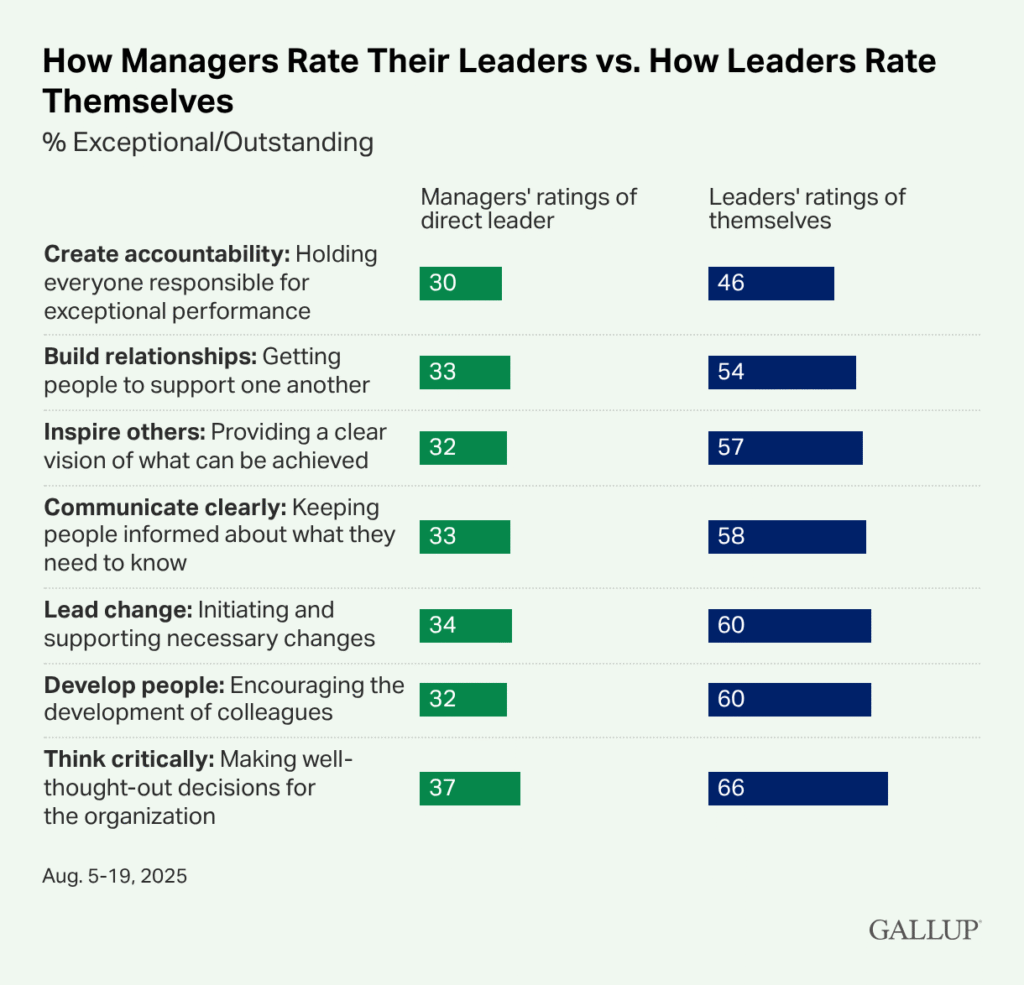
The headline in a recent report from Gallup proclaimed that “Accountability Is Leadership’s Greatest Weakness.” A closer look at the survey, however, tells a more complete story. Our greatest weakness as leaders actually isn’t accountability; it’s self-deception. When we perceive ourselves as better leaders than those around us do, we’re unlikely to lead to our full potential.
The Gallup survey found a consistent gap between the percentage of managers who rated their direct leader as “exceptional/outstanding” in seven core competencies and the percentage of those leaders who rated themselves as “exceptional/outstanding.”
For instance, 30% of the managers gave their leader a top rating for “creating accountability,” while 46% of the leaders gave themselves that rating. For “developing people,” meanwhile, it was 32% from the managers and 60% from their leaders. Here’s a link to the full results.
QUOTABLE
» Winning Words
The easiest thing in the world is self-deceit; for every man believes what he wishes, though the reality is often different.
– DEMOSTHENES
The Olynthiac


The heart is deceitful above all things and beyond cure. Who can understand it?
– Jeremiah 17:9 (NIV)
The true way to be deceived is to think oneself more knowing than others.
– FRANÇOIS DE LA ROCHEFOUCAULD
Reflections; or Sentences and Moral Maxims

DOABLE
» 3 Key Plays
1. Ask your truth-tellers to tell you the truth
We all need truth-tellers in our lives – people we trust, who know us well, and who are willing to shoot straight with us about our blind spots and weaknesses.
If you are married, that includes your spouse, but it also can include a mix of other family members, close friends, and peers. For instance, it should include at least a few people who are around you regularly and see your moods and your actions, not just college buddies who live on the other side of the country and only know what’s happening in your life by looking at LinkedIn, Facebook, or from an occasional phone call. You also want folks who knew you before you were successful and are less likely to treat you with kid’s gloves.
2. Ask your peers and direct reports for anonymous feedback
I’ve written previously and on more than one occasion about the value of 360-degree feedback assessments. When I was a CEO, I found those assessments super helpful for me and for our leadership team, even though some of the feedback stung! If we have a growth mindset, however, we recognize the sting as an opportunity for improvement. Sure, it hurts, especially if the feedback contradicts our bias, but it also helps us self-assess and make some much-needed adjustments to our leadership.
Never miss a post about leadership, transparency, and trust by signing up for my weekly mailing list, delivered right to your inbox. Sign up here.
3. Ask direct and indirect questions
The power of a 360-assessment is that the feedback is anonymous and therefore people aren’t likely to hold back what they really think. But face-to-face feedback still has its place.
The best in-person feedback comes when we’ve invested in relationships and developed trust so that people will feel safe telling us the truth about our leadership. Then we can expect insightful answers when we ask, “How am I doing as a leader?”
Beyond that, however, we can benefit from indirect questions about how we can serve the real needs, not just our perceived needs, of our direct reports.
Tom Muccio, a former P&G executive who was my guest in Season 3 of Off the Rak, would have everyone on his team write the top three problems they were trying to solve on a whiteboard in their office. Then when he would drop by in the afternoon, usually with some popcorn to share, and ask non-threatening questions.
How’s it going with these? What roadblocks are you facing? What does help look like? The answers to those types of questions can lead to practical help for our teams. But they also help us, as leaders, identify ways we could have been helping but weren’t. In other words, they help us spot and close the gaps.
The Monday Playbook delivers a quick, motivational plan to help you win your week as you tackle universal challenges in leadership, business, and life.